 Groundwind
Field notes on weather with no signal
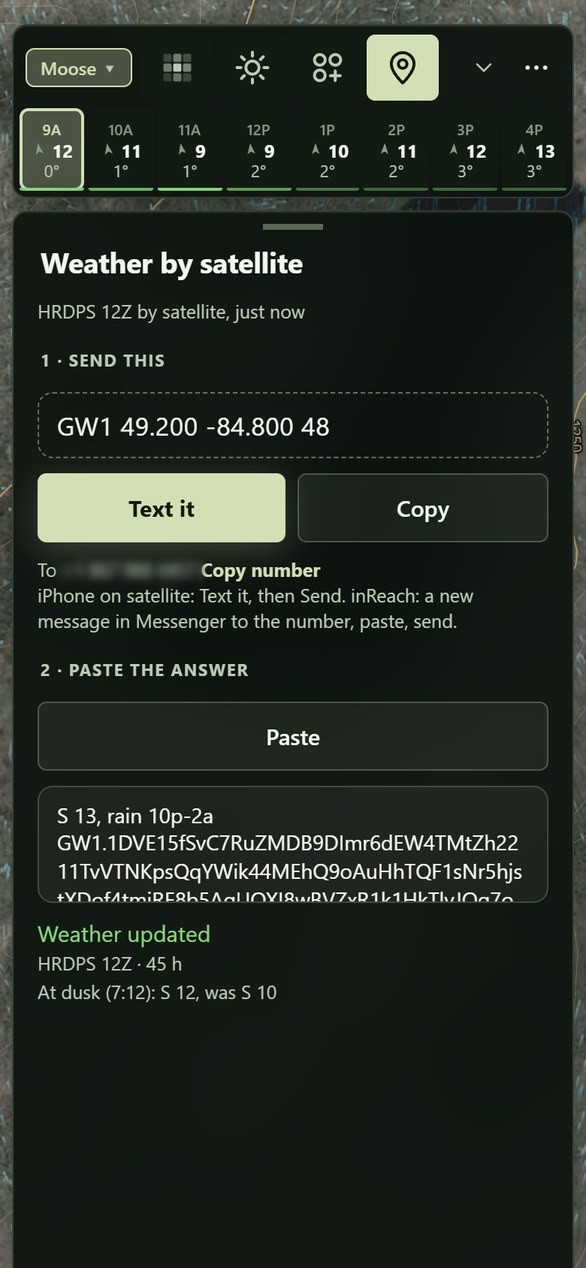
Weather by satellite text.
A few days past the last bar, the forecast on your phone gets old. Text one line from a Garmin inReach or an iPhone on satellite, and the newest HD forecast for your camp comes back in one text of 160 characters. Paste it into Groundwind and the wind, your scent cone and the heat map all run on it.
What comes back
One text, at most 160 characters. It holds the newest run of HRDPS, Environment Canada's HD forecast on a 2.5 km grid (ECCC). A new run comes out every six hours and reaches 48 hours ahead (Open-Meteo). The reply starts at the hour you ask, so it usually holds about 40 to 45 of those hours.
- The wind, hour by hour. Its direction and speed, and the gusts.
- Temperature, cloud and rain.
- The air above you. The temperature and wind 80 m (260 ft) up, which decide whether the forecast wind reaches the ground, and how sure Environment Canada's ensemble is of the wind's direction.
- A few plain words up front. The wind now, its first big change in the next day, and the first rain, for reading on an inReach's screen.
A reply starts like this, and runs on in letters and digits to 160 characters.
NW 11g40, calm by 9p GW1.cy3pKme2UAnxXGC4…
The words are for you. The code after GW1. is for the app. On twelve days of forecasts at our camp, 48 hours always fit in one text, and the code brought the wind back within 2.3° and 0.4 km/h of the full forecast on average, and the temperature within 0.4 °C.
And how the wind at dusk changed
How to do it
Before you go, with signal
- Save your area on the phone. ☰ → Settings → Maps on this phone → Download.
- Sign in. Weather by satellite comes with a Groundwind account, and the Groundwind number answers only a request it knows is yours. ☰ → Settings → Your account, then the code we email you.
- On an inReach, pair it with the Garmin Messenger app on your phone. The reply lands there, where you can copy it.
- On an iPhone, ask your carrier whether it sends texts by satellite. More on that below.
In the bush
- Tap ☰, then Weather by satellite. The app writes the line for your camp, like GW1 49.200 -84.800 48 and your account's six-letter key. That's your camp to about 100 m, and the hours you want.
- From an iPhone on satellite, tap Text it. Messages opens with the number and the line filled in. Send it. From an inReach, tap Copy, start a message in Garmin Messenger to the Groundwind number the app shows, paste and send.
- Put the phone away. The answer takes a few minutes, and the app remembers you asked. On an inReach, check for messages. With Apple's satellite, stay connected for it.
- Hold the reply and tap Copy. Open Weather by satellite again and tap Paste. It says Weather updated, which run it's from, and how the wind at dusk changed.
The hours go everywhere a download would. The wind at head height, your scent cone, the heat map and every place you've saved in the area run on them, and the hour detail says by satellite. The first time you have signal again, the full forecast comes in as usual.
If something's wrong, the app says so and keeps the forecast it had. A check in the code catches a reply that was cut short, changed on the way or meant for another area. Copy the whole message as it came and paste again, or send the request again.
Reading it by hand
On an inReach's screen, the words up front are the forecast at a glance. Speeds are in km/h, and times are your camp's.
- NW 11g40 is the wind now, from the northwest at 11 km/h (7 mph), gusting to 40 (25 mph). Gusts show when they're 8 km/h (5 mph) or more over the wind.
- calm by 9p is the first big change in the next 24 hours, here calm by 9 pm. A big change is a swing of 45° or more, or the wind 10 km/h (6 mph) stronger or lighter. Calm is under 3 km/h (2 mph).
- rain 10p-2a is the first rain in the next 24 hours, from 10 pm to 2 am. At about 0 °C (32 °F) or colder it says snow.
When the hours need the room, the words shrink to the wind now.
What it costs
Groundwind is free during the beta, weather by satellite included. What a forecast costs you is two texts on your device, the request and the reply.
On a Garmin inReach
An inReach texts a phone number over the Iridium satellites (Garmin), and Garmin counts texts and weather requests together. Here are its monthly plans and what each includes (Garmin).
| Plan | US$ a month | C$ a month | Texts and weather requests |
|---|---|---|---|
| Enabled | 7.99 | 10.99 | Pay as you go |
| Essential | 14.99 | 24.99 | 50 |
| Standard | 29.99 | 39.99 | 150 |
| Premium | 49.99 | 69.99 | Unlimited |
On Enabled, and past what's included on Essential and Standard, each one is US$0.50 (C$0.70). Activation is US$39.99 (C$54.99). So a forecast is about US$1 (C$1.40) on Enabled, or two of the texts in your plan. Essential's 50 work out to about 30 US cents each, and Standard's 150 to about 20.
On an iPhone
Messages via satellite works on an iPhone 14 or later with iOS 18 or later, in the US and Canada. Apple says it's free for two years after the iPhone is activated (Apple).
The Groundwind number isn't an iMessage contact, so your request goes as an ordinary text (SMS). Apple says SMS by satellite depends on your carrier, and carrier fees may apply (Apple). Ask yours before the trip.
On your carrier's satellite
Some carriers now send texts by satellite themselves, from the phone's own Messages app. T-Mobile's T-Satellite works across the US (T-Mobile), and Rogers Satellite works in Canada south of 58°N (Rogers). Each is open to other carriers' customers for a monthly fee, and comes with some plans.
The Groundwind number is Canadian, so a text to it costs what your plan charges for a text to Canada. Before a trip, ask your carrier whether its satellite texts reach any number.
Next to Garmin's own weather
An inReach already asks Garmin for the weather. It gets a basic, premium or marine forecast for where you are, a waypoint, coordinates or a point on the map, and shows it on the inReach itself (Garmin). A forecast counts as one of your plan's texts and weather requests (Garmin). It's built in and it goes wherever you go. Keep using it.
Groundwind's text does a different job. It brings the HD model, HRDPS on its 2.5 km grid, hour by hour for your saved camp, with the air above that decides whether the wind reaches the ground. Then the phone does the rest, because your ground and your bush are already on it. It works out the wind at head height over your ground and every stand of trees, draws your scent cone on your saved spot, and scores the heat map on the new hours.
Garmin's covers wherever you are. Ours covers the camp you've saved in Groundwind, and the app spreads it over the whole area.
Where it works
HRDPS covers most of Canada and the northern US (ECCC; Open-Meteo). On 26 October 2026 we checked where the copy the Groundwind number reads runs out.
- Canada. Everywhere we checked, from the border to the Yukon and the Northwest Territories.
- The western US. North of about 41.5°N. Washington, Oregon, Idaho, Montana and most of Wyoming are in. Colorado, most of Utah, Nevada and California, and the Southwest are out.
- The eastern US. It reaches further south, into Kentucky.
- Alaska. Only the east, around Fairbanks and the Wrangells.
Outside it there's no HD forecast to send, so the Groundwind number can't answer.
Questions hunters ask
Can I get a weather forecast on my inReach?
Yes, two ways. Garmin's own forecast comes up on the inReach's screen (Garmin). Groundwind's comes as a text, with its plain words on the screen and the hours for the app on your phone.
Can an iPhone get the weather by satellite?
Yes, by text. An iPhone 14 or later on iOS 18 can text by satellite in the US and Canada, and the Groundwind number answers with the forecast. The request goes as an ordinary text, so your carrier has to send SMS by satellite (Apple).
How much does a forecast cost on an inReach?
Two texts, the request and the reply. That's about US$1 (C$1.40) on the pay-as-you-go Enabled plan, or two of the 50 or 150 on Essential and Standard. Premium's texts are unlimited (Garmin).
Do I need signal to set it up?
Once. Sign in to your Groundwind account and save your area while you have signal. After that the app writes the request with no signal at all.
Does it work in Colorado?
No. HRDPS stops at about 41.5°N in the West, so Montana, Idaho, Wyoming, Washington and Oregon are in, and Colorado is south of it. Where it works.
No bars? Doesn't matter. The HD forecast comes by text.
Get the newest forecast with no bars.
Groundwind is a hunting app that works out the wind at head height for your spot, over your ground and every stand of trees, and draws your scent cone on it. A puff of powder corrects it. It works with no service, and one text brings the newest forecast.
Where these facts come from
Garmin, Apple and the carriers from their own pages, checked 26 October 2026. Plans and prices change, so check before you go. The accuracy figures are our own, from twelve days of HRDPS at our camp.
- Environment and Climate Change Canada. High Resolution Deterministic Prediction System (HRDPS). Free The 2.5 km HD forecast over most of Canada, 48 hours ahead, up to four runs a day.
- Open-Meteo. GEM API. Free HRDPS as the Groundwind number reads it, for Canada and the northern US, every 6 hours.
- Garmin, inReach consumer plans (US) and (Canada). Monthly prices, the texts and weather requests each includes, and the cost of each one past that.
- Garmin, Requesting an inReach weather forecast, GPSMAP 66i manual. Basic, premium and marine forecasts by inReach message, for where you are or a point you pick.
- Garmin, inReach Messenger manual, Messages. Texts to a phone number, an email address or another inReach, over the Iridium satellites.
- Apple, About Messages via satellite on your iPhone. iPhone 14 or later on iOS 18, SMS where the carrier supports it, free for two years after activation.
- T-Mobile, T-Satellite. Texting by satellite across the US, for T-Mobile's customers and other carriers'.
- Rogers Satellite and its FAQ. Texting by satellite in Canada south of 58°N, open to any carrier's customers.